On 26 October 2026 Belgium borrowed €1.3 billion for ten years at an average rate of 4.41%, up from 4.30% at the end of September. According to De Tijd, that’s the highest rate for a ten-year loan in fifteen years.
Headlines like that pass by every few months, but what actually happened? Let’s investigate.
It all started in December 2025.
Every year in December, the Belgian Debt Agency (Federaal Agentschap van de Schuld, or in French, Agence Fédérale de la Dette) picks the dates when it wants to issue or auction off bonds, or OLOs. For 2026, you can find the planning in this document, on page 9, titled “The OLO Issuance Calendar”.
OLOs?
Okay, let’s take a step back. By now you should already know that the Belgian government owes a lot of debt. In fact, this is nothing strange. Every government owes debt, but how exactly do they keep track of it? They do that by issuing OLOs, or at least that’s what they’re called in Belgium. OLO stands for obligation linéaire (lineaire obligatie in Dutch), which is a government bond.
You can compare it with an IOU.
An example
An OLO is basically a piece of paper that says: “I owe you an amount of money, I will pay you back on this date in the future and I’ll pay a certain amount of interest.”
Okay, so let’s fill in an OLO.
Let’s say the Belgian government wants to borrow €100.
They promise to repay it in 10 years.
They’re willing to pay a 3.40% interest rate.
Every year the owner of the OLO tears off a strip of interest, gives it to Belgium and gets their 3.40 euros.
In general, the riskier the loan, the higher the interest. If you have a very safe country that has low debt, low inflation, always pays its debt nicely and on time, and can always form governments that fully function and has no trouble making the budget (cough, cough), then its interest rate is going to be lower than that of a country with a lot of financial trouble, higher inflation and a more risky profile.
That’s also the reason why car insurance for a 20-year-old who just got their driver’s licence is higher than for a 45-year-old who’s never been in an accident and has had their licence for 20 years. More risk, higher premium. But I digress.
First sale in January 2026
That OLO above, 10 years @ 3.4%, was issued in January 2026 and nicknamed OLO 106 – remember that. Everyone was feeling pretty optimistic about the New Year and the future in general.
Belgium sold €8 Billion (with a B) worth of OLOs in January 2026 at this rate.
The crazy part?
They could have sold €91 Billion (still with a B) worth of OLOs at this rate. That’s how popular they were.
Buyers included bank treasuries, fund managers, central banks, pension funds, banks, and companies.
Fun fact: the UK bought a quarter of all of those OLOs. Thanks, UK!
What happened on October 26, 2026
As mentioned before, it was already on the calendar that Belgium could issue more OLOs on October 26.
The debt agency had a meeting with the prime minister and said: “Yup, we need to borrow some money”.
Mostly to pay off loans and debt from the past, by the way.
But it’s been 10 long months since the fresh New Year when everyone woke up and saw how peaceful the world looked under a blanket of fresh, white snow.
It’s October now. It’s gray, dark, and Belgium is having budget troubles (again). The markets deem it more risky to get Belgium’s OLOs, and even if they get them, they want a bigger yield than the 3.40% from January…
How do we fix this? We can’t simply issue new OLOs at a new interest rate: it costs money and each extra bond we add makes it more difficult to trade, because we are fragmenting the market.
Let me explain.
Right now we have 1 big market: the OLO 106 market. All our buyers and sellers are there.
When someone else wants to buy or sell, they will quickly find someone to trade with at a good price.
If we were to issue another bond every time the interest rate changes, we’d create a separate market, thus fragmenting the big market.
Trading is now much harder: there’s less liquidity, fewer traders, and it will take more time to get a good trade.
So how do we solve this?
By adapting the price!
Watch out, Halloween is early this year: scary maths ahead!
price = 3.40/(1+r) + 3.40/(1+r)2 + … + 3.40/(1+r)10 + 100/(1+r)10
r = the interest you want
Now that that’s behind us, let me explain it.
Our original OLO has a yield of 3.40%. Which means we lent Belgium €100 and would make €34 in profit, right? We get our €100 back at the end + €34 (10 years x €3.40 interest per year).
Let’s say the markets have low trust in Belgium because reasons. Instead of making €34 in profit, they want to make €68, double the original amount! The greedy bastards.
How do we solve this without issuing new OLOs at a higher interest rate?
By giving a discount. Instead of letting a bank buy an OLO at €100, we let them buy it at €66. Mind you, the actual value of the OLO is still €100, it’s only been discounted.
The bank still gets €3.40 every year (or 3.40% of €100).
At the end of year 10 when the OLO expires, Belgium pays the bank €100 + €3.40. In total the bank still gets €134 back (€100 + (€3.40 x 10 years)).
But they only paid €66 for it. €134 - €66 = €68 profit.
Spread over 10 years, that €34 discount is €3.40 a year extra, on top of the €3.40 interest. €6.80 a year on a €100 OLO: 6.80%, double the January rate.
One footnote. The market counts a bit more strictly than that, because a euro you get in 2036 is worth less than a euro today, and the €34 only shows up in 2036 when the €100 comes back. Run the €66 through the scary formula above and it spits out 8.60%, not 6.80%. Same €66, same €68 profit, stricter way of counting. That stricter number is the one in the headlines.
interest, €3.40 a yearyour discountyour €100 back
You pay , get back, so you make
That is also how those OLOs get traded on the market right now.
Imagine you bought 1 OLO @ 3.40% in January, and in February you had a vision (or more likely a déjà vu) and saw that making the budget was not going to be an easy task. So you want to sell your OLO and use your cash to buy bonds of France – a much better investment!
However, no one wants to buy your OLO for €100. So you discount it a little bit, perhaps sell it at €99. Et voilà.
How did they decide on the 4.41% average rate?
Now back to October 26. The Debt Agency licked their finger, put it in the air, and came to the conclusion that they wanted to issue some OLOs.
They then did the maths, and when they finished posted an announcement saying as much: 3 OLOs for sale (including our beloved OLO 106), €2 to €2.8 B in total.
Then what follows is a sealed bid. All parties who are interested in these OLOs place their bids without seeing anyone else’s. Comparable to how they would write it on a piece of paper, put it in a sealed envelope and give the envelope to the Debt Agency.
Next, the Debt agency opens all those envelopes and orders the bids from low to high. The lower the bid, the bigger the discount, so the more expensive for Belgium.
The bid of €67 from the Gen-Z bank automatically gets rejected, but all the other bids are pretty close together – it’s a matter of cents.
In October, the highest bid the Debt Agency received was €92.19, and the lowest was €91.91.
They drew the line at €92.13; everything below that they rejected.
In total they sold €1.295 billion worth of OLOs. They only received €1.19 billion of cold hard cash.
The €101.6 million difference is the extra interest Belgium pays on top of the 3.40% coupons.
Reverse the formula, and selling a €100 OLO @ 3.40% for only €92.13 works out to an actual interest rate of 4.41%.
And that’s how Belgium ended up borrowing at its highest rate in 15 years.
Congrats, you’re now an expert in government bonds, and you’re declared the successor of Lagarde at the ECB.
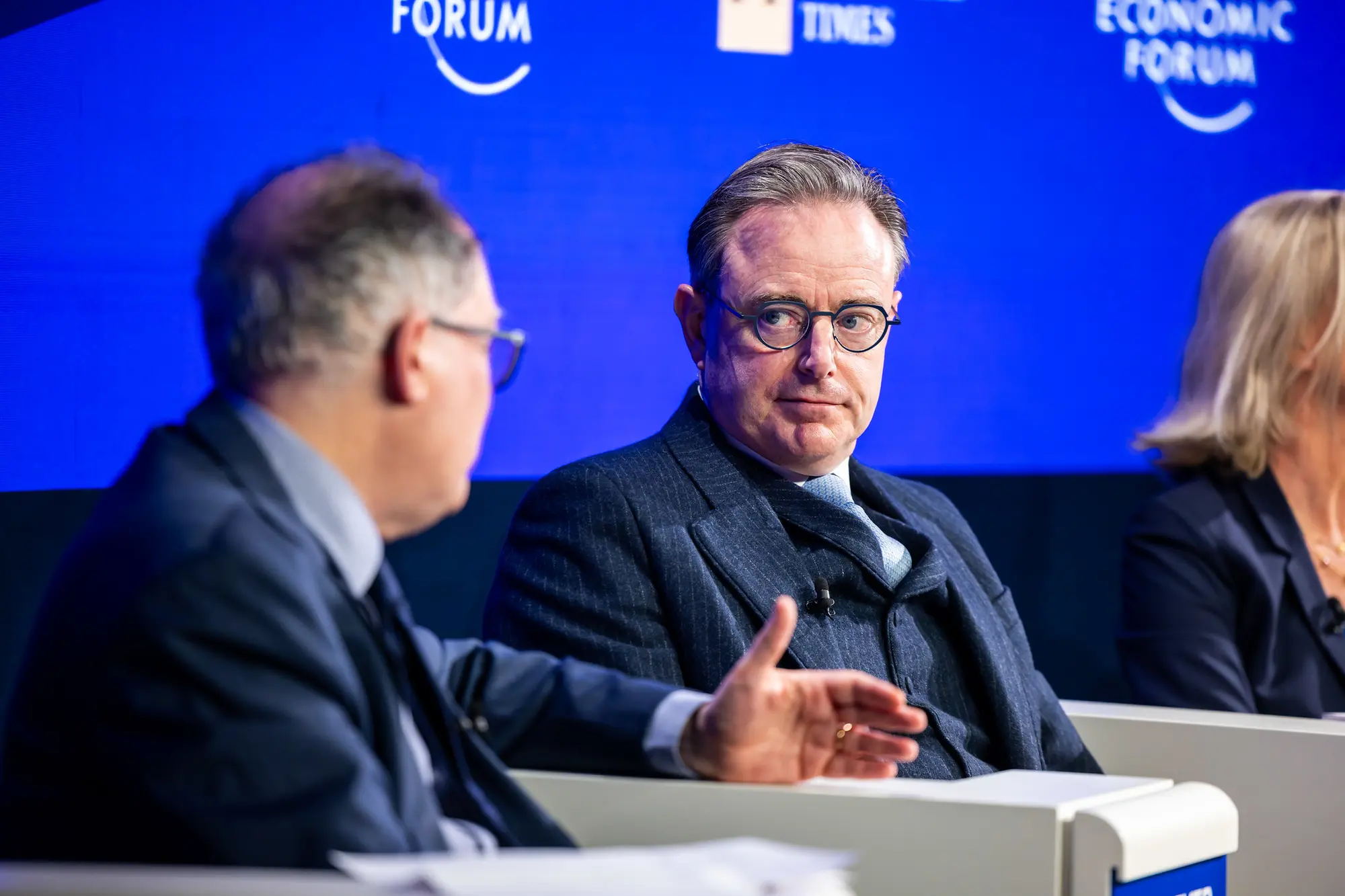
Data: ten-year government bond yields from the ECB and OECD; auction results via De Tijd and Belga; debt figures from the Federal Debt Agency. Cover photo: Bart De Wever at the World Economic Forum Annual Meeting 2026, © World Economic Forum, CC BY-NC-SA 4.0.